
Hero Wars Stat Explained | Hero Wars Dominion Era

Whether you started yesterday or you have been fighting in Dominion for years, this Hero Wars Stat Explained guide is built to finally make your hero screen make sense. Most players look at one number first — Power — and assume a bigger total automatically means a stronger hero. That assumption, however, is exactly what holds so many Guardians back.
The figures that truly decide a fight are sitting quietly inside your hero’s stats. Once you understand what each one actually does, you stop guessing and start seeing why one hero tanks a hit, why another melts, why an attack whiffs, and why a “weaker” team can still crush you. So let’s break it all down from the ground up.
Hero Wars Stat Explained: Start With the Main Stat
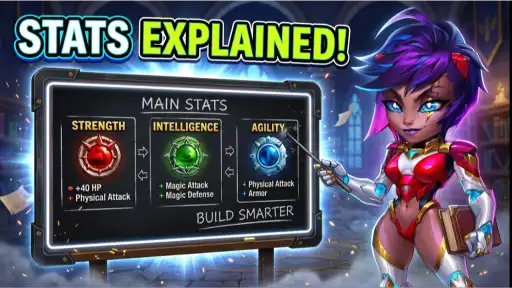
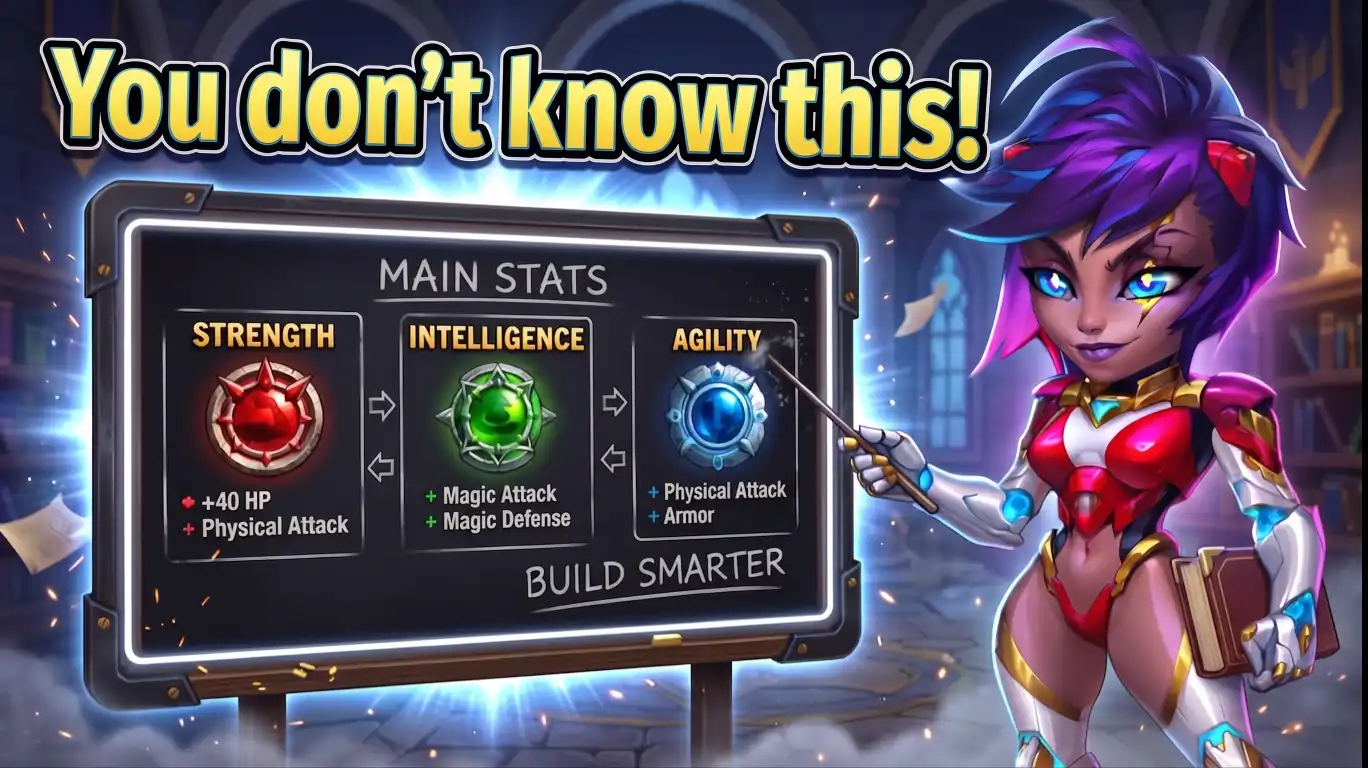
Every hero owns one main stat — Strength, Intelligence, or Agility. Think of it as part of that hero’s identity, because it feeds their secondary stats and grows naturally as you develop them. Therefore, understanding the main stat is the first real step toward building smarter instead of just chasing a higher Power number.
Strength
Each point of Strength grants 40 Health. In addition, when Strength is the hero’s main stat, every point also adds 1 Physical Attack. As a result, Strength heroes are natural punishment-soakers — the more Strength they gain, the more Health arrives right alongside it.
You will usually see this on frontline bruisers. Galahad is the easiest example, since almost every Guardian meets him at the very start, while Aurora is another familiar wall. Heroes such as Lyria and Electra also lean on Strength as their main stat.
Intelligence
Every point of Intelligence provides 3 Magic Attack and 1 Magic Defense. Moreover, if Intelligence is the main stat, it also grants 1 Physical Attack. This is where your mages and magic-flavored supports live.
Orion is a perfect example, because Intelligence directly feeds the offensive numbers a mage craves and helps explain how these heroes develop such punishing spells. Augustus fits the same mold, and so do heroes like Aidan and Cornelius.
Agility
Each point of Agility gives 2 Physical Attack and 1 Armor. On top of that, when Agility is the main stat, it adds another 1 Physical Attack. Consequently, Agility becomes essential for many physical carries and a handful of supports.
Lara Croft is the obvious poster child — a physical damage dealer built entirely around Agility. Sebastian shares that same main stat, as do Nebula and Isaac.
Here is the early lesson: never read a stat in isolation. The main stat feeds everything else, so a hero’s role, abilities, and position all interact with those numbers. Keep that in mind, and the secondary stats suddenly become far easier to read.
Secondary Stats That Decide Every Battle
With the foundation in place, the secondary stats are where fights actually become readable. Let’s start with the simplest one and work outward.
Health
Health simply measures how much damage a hero can absorb before falling. When it reaches zero, that hero leaves the battle. Simple — yet decisive, because a frontliner who survives a few extra seconds might land one more ultimate or shield your backline just long enough to flip the entire result.
Physical Attack and Armor
Physical Attack fuels basic attacks and physical abilities. That damage, however, rarely lands untouched, since the enemy carries Armor specifically to soften it. Armor reduces incoming physical damage — but the relationship is not linear, and that catches beginners out constantly.
For example, roughly 1,000 Armor equals about 25% physical damage reduction, while roughly 3,000 Armor equals about 50%. Tripling the Armor, therefore, does not triple the protection. Instead, each additional point delivers diminishing returns.
Armor Penetration
Because Armor guards the enemy from your physical hits, you need a way to punch through it. Armor Penetration effectively lowers the Armor working against your attacks. Imagine a target with 8,000 Armor facing a hero with 6,000 Armor Penetration — those attacks now deal with only 2,000 effective Armor.
There is a hard ceiling, though. Penetration cannot drop a target’s effective Armor below zero, so once you fully cancel their Armor, extra penetration against that same target adds nothing. In short, more is not always better — you have to know exactly what you are fighting before you stack it.
Vampirism
Vampirism heals a hero for a percentage of the damage they deal, covering both basic attacks and abilities. As a quick example, a hero dealing 1,000 damage with 10% Vampirism recovers 100 Health. Now picture that across relentless attacks and huge ability bursts — suddenly a carry sustains itself simply by keeping the pressure on.
The Magic Side — Magic Attack, Defense, and Penetration
The magical stats mirror the physical ones almost perfectly, so if the last section clicked, this part is easy. Magic Attack powers magic abilities and boosts effects that scale from it. Meanwhile, Magic Defense reduces incoming magic damage, and Magic Penetration lowers the enemy’s Magic Defense for your spells.
That defense follows the very same curve as Armor: about 1,000 Magic Defense trims roughly 25% of magic damage, while about 3,000 trims roughly 50%. Once again, diminishing returns apply, so raw stacking rarely pays off the way beginners expect.
Think of them as two matching systems. Physical Attack meets Armor, and Armor Penetration fights back; likewise, Magic Attack meets Magic Defense, and Magic Penetration answers. Learn one side, and the other instantly falls into place.
Dodge and Critical Hit Chance — the Stats Guardians Misread
Two stats in this Hero Wars Stat Explained breakdown trip up new Guardians more than any others, largely because the displayed number does not mean what people assume it means.
Dodge
Dodge gives a hero the chance to completely avoid an incoming physical attack. That word — physical — is everything, because Dodge does nothing against magic. You can stack impressive Dodge and still watch a hero get erased by spells.
Another detail matters here too: your real dodge chance depends on the gap between your Dodge stat and the enemy hero’s main stat. As a result, the number on your hero never converts into one fixed percentage against every opponent — the stronger the enemy’s relevant main stat, the lower your effective dodge.
Critical Hit Chance
Critical Hit Chance lets physical attacks land a crit for double physical damage. Notice the pattern once more — physical only, so crits never apply to magic. Much like Dodge, your effective crit chance shifts with the opponent’s main stat, which means the same number behaves differently from one enemy to the next.
Why Power Isn’t Everything
Now the big picture finally snaps into focus. Your main stat sets the foundation, Health decides how long you last, and Armor blunts physical damage while Armor Penetration cracks it open. On the other side, Magic Defense guards against spells, Magic Penetration tears into it, Vampirism turns your damage into healing, Dodge erases physical hits, and Critical Hit Chance doubles them. Underneath all of it, Strength, Intelligence, and Agility keep quietly shaping the math.
So instead of asking “why does this hero have more Power?”, you start asking sharper questions. Does my carry have enough penetration for the Armor I am facing? Is my frontline actually surviving long enough to matter? Am I leaning on Dodge against a mostly magical team? Those are the questions that quietly win battles.
How to Read Your Own Heroes
Want to see these numbers for yourself? Open the Heroes menu, pick a hero, and head into the Stats section. Everything that once looked like meaningless noise now tells you exactly what that hero can do.
That is the whole point of this Hero Wars Stat Explained walkthrough — you do not need to memorize every formula overnight. Once you can read the numbers, you can read the battle, and once you can read the battle, you can spend your resources exactly where they truly matter.
Keep Reading
- Should You Build Cornelius in Hero Wars? — a closer look at one of the Intelligence heroes mentioned above.
- Mushy Team Synergy Guide — put your stat knowledge to work when pairing heroes.
- Path of Legends Event Mistakes — common slip-ups that cost Guardians rewards.
- Path of Legends Shop Guide — spend your event currency where it counts.
Master Your Stats With the Community
Got a build question, or want a second opinion before you invest? Jump into the Hero Wars Olympus Discord — Guardians of every level are breaking down stats, teams, and events every single day.