
Hero Wars Summoners Review: Year-End Reflections in Alliance

Introduction: Examining the Year of Summoners in Hero Wars Alliance
As 2025 draws to a close, the release of Lumira provides the perfect opportunity to reflect on the changes summoners brought to Hero Wars: Alliance this year. Summoners have dramatically shifted the titan battlefield, creating powerful offensive options while highlighting certain predictable patterns. In this Hero Wars summoners review, we will break down the year’s key developments, explore the strengths and weaknesses of each summoner, and identify the three main disappointments that the community has quietly noticed. Let’s take a closer look and see if your experiences align.
Verdoc: Dominance of Earth Titans– Hero Wars Summoners Review

We begin with Verdoc, the King of Earth. Upon arrival, Verdoc’s power was overwhelming. He didn’t just feel strong — he was overpowered, and even that word might be generous. Five Earth titans led by Verdoc on offense could dominate nearly any encounter. Win rates approached ninety-eight percent against defensive lines, even at lower investment levels, making them brutally effective.
Of course, counters exist, but avoiding Fire or Araji-based defenses allows Earth teams to carry almost effortlessly. The crucial point, however, is the requirement for five Earth titans. This necessity became a central theme that defined gameplay throughout the year.
Asherona: Reinforcing Fire’s Strength– Hero Wars Summoners Review

Next, we turn to Fire and the arrival of Asherona. She may not have been as overwhelmingly powerful as Verdoc, yet she gave Fire the boost it had long been missing. With Asherona, five Fire titans could dismantle almost every defensive formation. While not quite as dominant as Earth, the effect was strong enough to feel repetitive.
Similarly, avoiding Water defenses ensures success, making five Fire titans a reliable and predictable force on offense. The rule of elemental concentration remained consistent.
Tydus: Water’s Gradual Pressure– Hero Wars Summoners Review
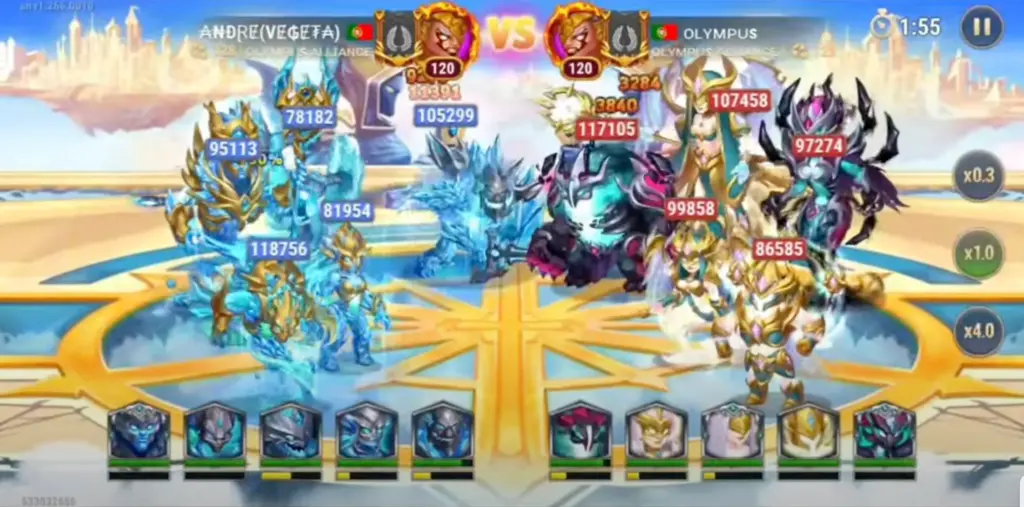
Water received its long-awaited enhancement through Tydus. Unlike Verdoc or Asherona, Tydus is slower but steady and methodical. Teams of five Water titans do not rush; instead, they gradually grind down opponents. Moreover, Over time, with persistence and consistent pressure, they achieve the same high success rates — close to ninety-eight percent.
Again, avoiding Earth on defense ensures that five Water titans reach their objective effectively, continuing the pattern of single-element dominance.
Lumira: Light Titans’ Devastating Offense– Hero Wars Summoners Review

Finally, we reach Lumira, the most recent summoner. Moreover, like Verdoc, she feels exceptionally strong, almost to the point of being broken. Five Light titans on offense can be devastating. While Earth and Fire defenses occasionally challenge her effectiveness, these situations are exceptions rather than the rule.
In practical terms, five Light titans dominate with ease, reinforcing the trend of overwhelming single-element teams.
Three Key Disappointments with Summoners: Hero Wars Summoners Review
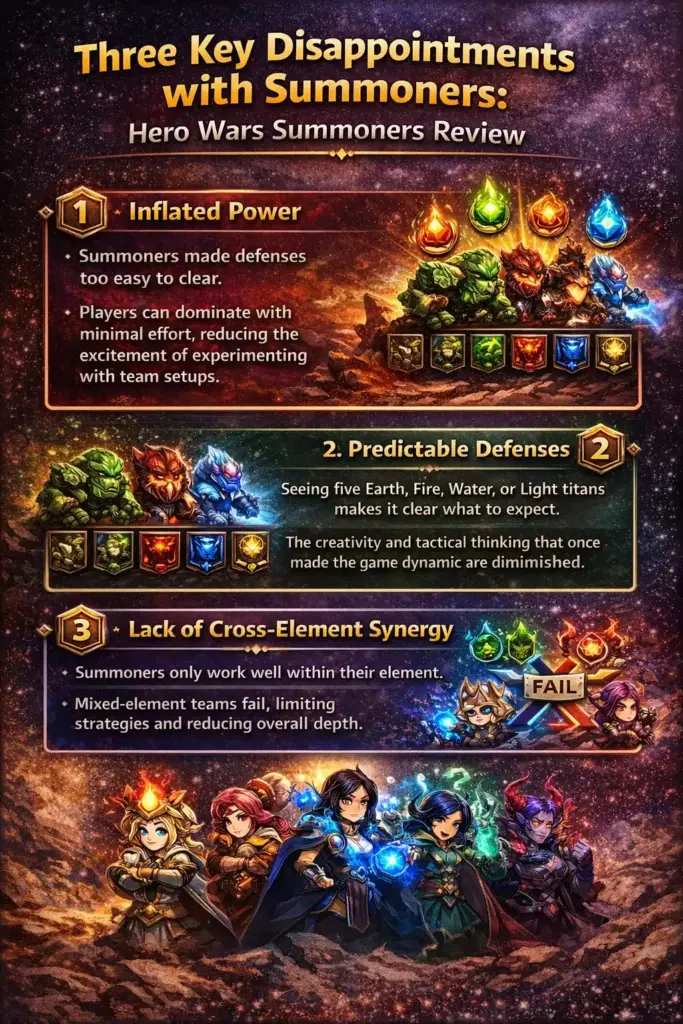
Now in Hero Wars Summoners Review, despite their power, summoners brought certain disappointments that affected the overall gameplay experience in Hero Wars: Alliance.
1. Inflated Power
While it is expected that new content introduces stronger heroes, summoners did more than that. Their mechanics allow defenses to be cleared quickly, consistently, and with minimal strategic effort. For many players, this ease diminishes the satisfaction of testing and experimenting with different team compositions.
2. Predictable Defenses
Summoner defensive lines are highly predictable. Seeing five Earth, Fire, Water, or Light titans makes it clear what to expect. The creativity and adaptive thinking that previously defined Hero Wars: Alliance — through synergy, counterplay, and tactical interaction — have become far less relevant.
3. Lack of Cross-Element Synergy
The biggest disappointment is the inability to create synergy between different elements. Initially, summoners promised opportunities for mixed titan lines that would require careful planning. Concepts like combining Angus with Eden and Verdoc or pairing Iyári with Solaris for unique support strategies generated excitement.
However, summoners perform effectively only within their own element. Remove one titan or attempt a mixed-element team, and the strategy collapses. This limitation forces players to rely on uniform five-titan lines, reducing strategic depth and experimentation.
Final Thoughts: Year-End Reflections on Summoners
This year, summoners have undeniably changed Hero Wars: Alliance, yet they have also made battles simpler and more predictable. Elemental uniformity dominates, and the ability to experiment with creative combinations has diminished. For those who enjoy testing, experimenting, and pushing the boundaries of strategy, this development is a reminder that depth and challenge have been sacrificed for raw power.
Looking ahead, there is hope that future updates, reworks, or skins might allow mixed-element synergy once again, restoring the layered strategic experience that once made this game engaging.
FAQs: Hero Wars Summoners Review
Verdoc led five Earth titans to nearly ninety-eight percent win rates against defensive lines. Avoiding Fire or Araji defenses allows Earth teams to perform almost effortlessly.
Asherona provided Fire with the offensive boost it was missing. With five Fire titans, most defenses could be dismantled predictably and effectively.
Tydus applies consistent pressure with five Water titans. His slower approach gradually overcomes defenses while maintaining high success rates.
Lumira enables five Light titans to dominate offense with ease. While Earth and Fire defenses occasionally challenge her, she remains overwhelmingly effective.
Summoners only work well within a single element. Mixed-element strategies fail, reducing creativity, strategic depth, and synergy that were once central to Hero Wars: Alliance.