
Iris Damage Mechanics: Why Her Rework Feels Overpowered in Hero Wars Alliance


Why Iris Has the Community Talking
Iris has become a headline-grabbing hero in Hero Wars Alliance. Lately, she has been eliminating heroes who were never meant to fall so quickly, including the evasive Octavia, in players’ battles.. Her rework has made her hit faster, harder, and more efficiently, turning battles upside down. Naturally, Iris’s sudden power prompts questions: is she overtuned? Is she broken? Or is her damage a result of clever mechanics that players simply don’t understand yet?
The truth is surprising yet simple. Iris’s damage spike is not a bug. Instead, it reflects how her reworked kit interacts with battle conditions, rewarding teams that consistently apply debuffs. Once you understand her mechanics, her previously “chaotic” damage becomes clear, logical, and entirely intentional. Read the full Iris Damage Mechanics guide.

Inner Fire: The Core of Iris’s Damage

The key to Iris’s explosive damage lies in her skill, Inner Fire. At first glance, Inner Fire might seem like a simple damage-over-time skill, but it is actually a complex stacking system. Each time a debuff is applied to an enemy, Iris adds an Inner Fire charge to that target. These charges deal damage every second while the debuff remains active.
For example, when you see “8,786 damage (5% Magic attack + 2,400) per second for every Inner Fire charge,” it means that each charge is an independent damage source, and multiple charges stack on top of each other.
Furthermore, if an Eternity hero applies a debuff, Inner Fire deals an additional 17,572 damage (10% Magic attack + 4,800) per charge. This creates a burst effect alongside the per-second damage, meaning multiple Eternity debuffs result in multiple simultaneous bursts.
In essence, Inner Fire works in three layers: first, each debuff creates a charge; second, charges deal damage every second; third, Eternity heroes amplify the damage and add extra bursts. Additionally, a target can hold up to five charges, which allows multiple damage sources to tick simultaneously. This is why Iris can sometimes appear to deal overwhelming damage in just a few seconds.
Why Iris Can Deal Damage After Death

Another point in Iris Damage Mechanics that confuses players is that Iris can continue dealing damage even after she dies. If you watch a battle carefully, you may see Iris removed from the battlefield, yet enemies continue to burn. At first glance, this seems impossible and leads many to assume a glitch.
However, the mechanics explain it clearly. Inner Fire charges are tied to debuffs, not Iris herself. As long as the debuffs remain active, the charges continue dealing damage. In teams that consistently apply debuffs — especially those with Eternity heroes — these charges can persist and keep ticking long after Iris is gone.
The charges only disappear if the debuff expires, the enemy cleanses it, or no new debuffs refresh its duration. This means the ongoing damage is entirely intentional and operates exactly as designed, even if it appears surprising at first glance.
Why Her Damage Looks “Insane”

Now in Iris Damage Mechanics guide, Many players describe Iris’s damage as overwhelming, but it is the result of multiple mechanics interacting at once. Inner Fire stacks with each debuff, ticks every second, and interacts with Eternity heroes to add burst damage. Furthermore, by constantly pushing targets to the maximum charge limit, Iris can deal multiple simultaneous damage sources.
What may seem like a single overpowering hit is actually several legitimate hits happening at the same time. Once fully understood, this reveals that Iris is not broken — she is performing precisely according to the developers’ design.
Key Takeaways About Iris Damage Mechanics
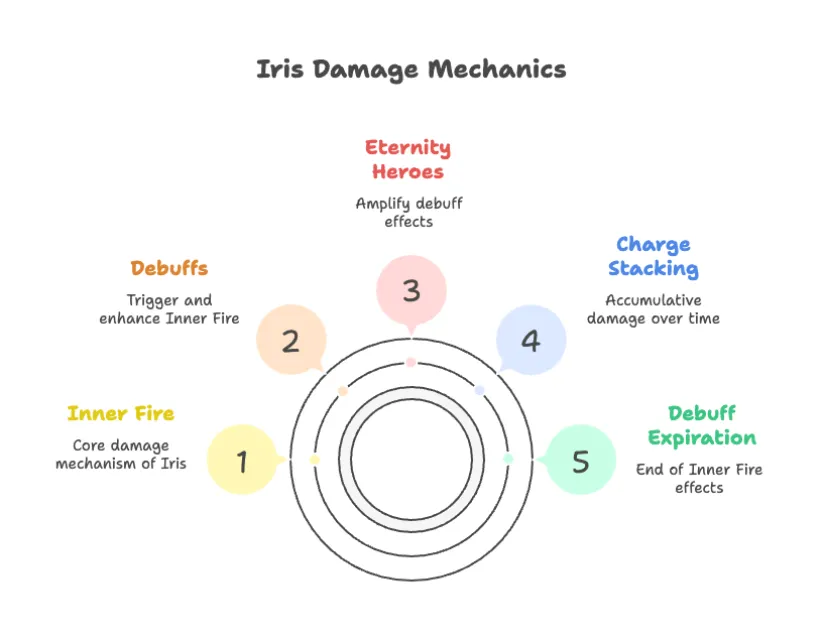
- Inner Fire creates multiple charges for every debuff applied, each dealing damage per second.
- Debuffs from Eternity heroes increase the damage and trigger additional bursts.
- Targets can hold up to five Inner Fire charges at a time, creating stacked damage.
- Inner Fire continues ticking after Iris dies because the charges belong to the debuffed enemy.
- Charges disappear only when debuffs expire, are cleansed, or no longer refreshed.
- Her damage numbers are fully consistent with the skill’s mechanics.
By understanding these details, players can predict and control how Iris deals damage instead of being surprised by it.
For more guides, visit the Hero Wars Alliance blog on our website
FAQs About Iris Damage Mechanics
Iris’s Inner Fire skill generates multiple charges for every debuff applied. Each charge deals damage per second, and debuffs from Eternity heroes add burst damage. Multiple charges and bursts hitting at once create the appearance of instant deletion.
Inner Fire charges are tied to the debuffs on enemies, not Iris herself. As long as the debuffs remain active, the charges continue to deal damage independently of Iris’s presence on the battlefield.
Debuffs from Eternity heroes double the damage of Inner Fire charges and add extra burst effects, significantly increasing overall damage output.
A target can hold up to five Inner Fire charges at a time. Iris constantly pushes enemies to this cap to maximize damage.
No. Iris is functioning exactly as intended. Her seemingly “bugged” damage is a result of Inner Fire stacking, ticking, and interacting with debuffs according to the skill’s mechanics.