
Tempus Relics Explained | Hero Wars Alliance


Tempus Relics Explained — and this is not a minor upgrade. If you already know what Tempus does on the battlefield, you already sense that adding relics to his kit is a transformation. Tempus has always been about control, about slowing fights down and forcing enemies to play on his terms. Now, with relics in the picture, the question is not just how much stronger he becomes — it is what kind of hero he turns into.
Today we go step by step through every relic level, analyzing each mechanic and what it means for how you build and position Tempus in your team. Essentially, this is about direction — not just numbers.
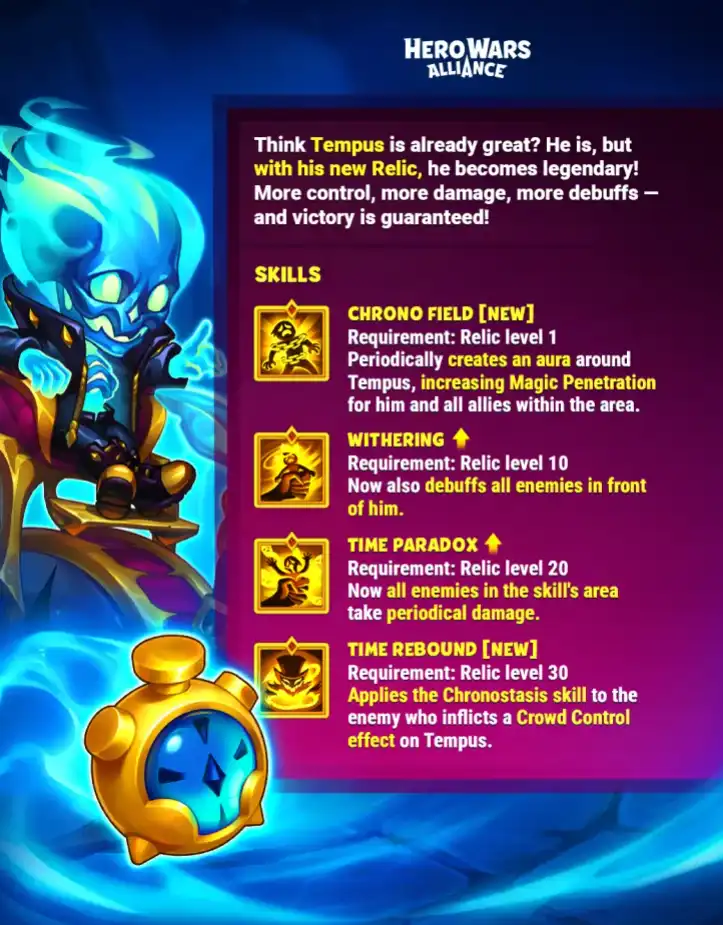
Relic Level 1 — Chrono Field
At first glance, the level 1 relic looks straightforward. In practice, however, it carries more weight than the description suggests. Tempus creates an aura around himself that increases Magic Penetration for him and all allies standing inside it.
That one detail — “all allies inside it” — immediately tells you this is not a selfish mechanic. Instead, it functions as a team-wide amplifier, and that changes his role from the ground up.
Magic Penetration is one of the most impactful stats for dealing damage against high-defense targets. Specifically, it allows magic damage to bypass resistance, so more of your raw output actually lands. When this stat becomes an aura, every mage inside the field benefits automatically.
The key word is positioning. This aura is not global — it is area-based. Therefore, Tempus becomes a center point, a formation anchor. Suddenly your team composition is not just about synergy between heroes — it is about who stands where and when they benefit from that field. That adds a layer of depth that was not there before.
In other words, from relic level 1, Tempus is not just controlling the fight. He is enabling it.
Relic Level 10 — Withering
This is where the first real escalation begins. Rather than only buffing allies, relic level 10 adds active debuffs to the equation. Enemies standing in front of Tempus now suffer a weakness — and that creates a powerful combination when you stack both effects together.
Your team gains output through Magic Penetration. Meanwhile, the enemies lose effectiveness at the same time. Amplifying damage from two directions at once is one of the strongest dynamics in the game.
Consequently, positioning becomes critical again here. The debuff applies in front of Tempus — not globally, not randomly. A well-placed Tempus does not just support your team — he actively targets the most dangerous heroes on the enemy side with a constant weakness.
Key insight: Weakened enemies benefit every damage dealer on your team — not just mages. Physical carries, mixed teams, burst heroes — all of them hit harder against a debuffed target. This mechanic is not class-restricted, which makes Withering one of the most universally valuable effects in the entire relic chain.
Relic Level 20 — Time Paradox
Relic level 20 is where Tempus stops being purely a support and starts applying real pressure. Enemies inside the area now take periodic damage — and not the kind that can be countered easily.
Unlike most damage sources, this damage over time cannot be dodged, reflected, or missed. Every tick lands regardless of whatever defensive setup the enemy team has built around. There is no counter for it — only absorbing the loss.
As a result, Tempus now applies guaranteed pressure — not burst, not conditional damage, but constant unavoidable tick damage that continues throughout the entire fight.
Layer this on top of what came before: allies gain increased Magic Penetration, enemies suffer a weakness debuff, and on top of that, every enemy inside the zone continuously loses health with no way to avoid it. Together, you get a control zone where enemies are always at a disadvantage — taking damage and moving toward a worse state as the fight progresses.
At this point, Tempus becomes a pressure engine. Rather than relying on a single decisive moment, he wins through consistent, compounding influence over the battlefield.

Relic Level 30 — Time Rebound
This is the relic that moves Tempus from strong into potentially meta-defining territory. At level 30, Tempus applies Chronostasis to any enemy that tries to crowd control him.
In plain terms — if you try to disable Tempus, you risk disabling yourself instead.
This is counter-control, not just defense — it is punishment. Normally, the standard playbook for dealing with control heroes is to stun or silence them early before they can act. Time Rebound breaks that playbook completely. Now every opponent who tries to shut down Tempus has to weigh the risk of losing their own hero to Chronostasis in return.
Why this matters at high level: Hesitation creates mistakes. Mistakes create openings. Tempus is no longer just influencing the fight through his own actions — he is influencing the decisions of the enemy team before they even make them.
What Do All Four Relics Mean Together?
When you look at the full relic chain, what stands out is how deliberately each layer builds on the last. This is not a collection of random stat boosts — it is a designed system.
- Relic 1 — Chrono Field: Aura that increases Magic Penetration for all allies inside it
- Relic 10 — Withering: Enemies in front of Tempus are weakened
- Relic 20 — Time Paradox: Periodic unavoidable damage over time in the zone
- Relic 30 — Time Rebound: Chronostasis punishes enemies that try to crowd control Tempus
Together, Tempus buffs allies, weakens enemies, applies constant guaranteed pressure, and punishes attempts to shut him down. No single relic alone defines this — the power comes from all four working at the same time.
Is Tempus Now a Mage Booster — or Something Bigger?
The honest answer is both — and more. Magic Penetration on the aura clearly makes Tempus exceptional for mage-heavy teams. The Withering debuff, however, benefits physical and mixed compositions just as directly. Any damage dealer performs better against a weakened target.
What makes this particularly interesting is that Tempus does not lock into a single team archetype. Instead, he expands possibilities across the board. Mage core teams gain a penetration multiplier. Control setups gain a hero who punishes counter-play. Mixed teams, furthermore, benefit from both the debuff value and the guaranteed zone damage. That kind of flexibility is what separates a good hero from a meta-shifting one.
Ultimately, the real results will come from live testing across different compositions — mage-heavy builds, control setups, mixed teams — but the mechanics already point in a clear direction. Tempus is not staying the same. These relics represent a genuine transformation of what he can do and how much influence he carries in a fight.
More Hero Wars Alliance Guides
- Hero Wars Alliance — Phobos Relics Guide
- Hero Wars Alliance — Control Strategy Guide
- Hero Wars Alliance — Kayla Tips
- Oya Talisman Guide 2026
- Elmir Talisman Guide 2026
Join the Olympus Alliance Community
Share your Tempus builds, ask questions, and get live updates as we test these relics in real battles. The community is active, the discussions are real.