
The Best Crow Teams Compositions | Hero Wars Alliance


The Best Crow Teams are already reshaping how players approach team building in Hero Wars Alliance, and after hundreds of battles inside our training grounds, one thing became crystal clear. Crow isn’t just another anti-mage hero. He’s a hero that completely changes how you construct a roster from the ground up.
Before we dive in, let’s be honest about one thing. It is still too early to call any of these the definitive best Crow teams. The hero only just arrived, the meta is still evolving, and players around the world are experimenting every single day. New interactions, new counters, and new combinations keep surfacing constantly.
So this breakdown isn’t about claiming these are the only compositions you should ever run. Instead, these are the teams that immediately stood out during our own testing. Each one performed at an extremely high level, and several kept making us stop, look at each other, and admit that the results were genuinely insane. That potential is exactly why we’re sharing them with you today.
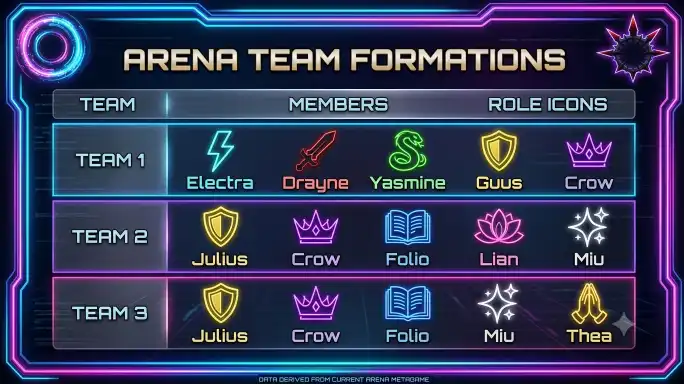
Team One — Relentless Pressure With Crow
This first composition is absolutely relentless. Every hero shares one mission: keep the enemy under constant pressure from the very first seconds of the fight.
| Hero | Role |
|---|---|
| Crow | Silence and battlefield disruption |
| Electra | Offensive support and pressure |
| Drayne | Explosive physical damage |
| Yasmine | Priority target elimination |
| Guus | Frontline anchor and survivability |
Crow immediately begins applying Silence across the battlefield, which alone starts limiting what Intelligence-based heroes can do. Then Electra enters the equation. She provides excellent offensive support while raising the team’s overall pressure, letting your damage dealers become even more threatening.
Next comes Drayne, one of the most explosive physical damage heroes in the game. Every second Crow spends disrupting the enemy backline is another second Drayne can freely build momentum. Once he starts snowballing, fights end incredibly quickly.
Yasmine adds the finishing touch. She’s constantly hunting isolated targets — heroes unable to react, unable to protect themselves, unable to stabilize their team. Crow creates exactly those openings, and while the enemy struggles to regain control, Yasmine eliminates priority targets one after another. Guus then serves as the perfect anchor, keeping the frontline stable, reducing incoming pressure, and buying the rest of the squad enough time to apply damage while Crow keeps the battlefield in chaos.
What we love most about this composition is that it never gives the opponent breathing room. Pressure, control, burst, and survivability all work together seamlessly.

Team Two — The Suffocation Composition
Here’s something that genuinely surprised us during testing. Who exactly said Crow should only be played with physical attackers? Honestly, nobody. If you actually read his kit carefully, nothing suggests it either.
Crow doesn’t buff physical damage. He doesn’t require physical carries, and he doesn’t force one specific archetype. What he rewards is control, which is a completely different thing. Never let yourself get trapped by labels — always test, always experiment, because the strongest discoveries often happen when you ignore what everyone else believes.
| Hero | Role |
|---|---|
| Julius | Frontline stability |
| Crow | Constant Silence spread |
| Folio | Enemy positioning manipulation |
| Lian | Additional disruption |
| Miu | Heavy enemy control |
This team is beautiful to watch. Rather than overwhelming your opponent with raw damage, it slowly takes complete control of the fight. Julius provides the stability the composition needs to survive the opening exchanges, and once that foundation is set, everything else clicks into place.
Crow constantly spreads Silence throughout the battlefield while Folio manipulates enemy positioning, grouping opponents together and making the fight increasingly uncomfortable for them. When enemies get grouped, Crow’s control becomes even more oppressive. Lian layers on more disruption, so every moment the enemy spends unable to execute their strategy turns into another opportunity for your team to dictate the pace.
Then comes Miu, one of the strongest control heroes currently available. Between Miu’s control tools, Lian’s disruption, Folio’s battlefield manipulation, and Crow’s relentless Silence, the opponent spends an unbelievable amount of time simply trying to recover.
This isn’t a burst composition — it’s a suffocation composition. You’re not winning because you hit harder. You’re winning because the enemy never gets the chance to play the game, and watching this team function together is incredibly satisfying.
Team Three — Double Silence Synergy
Now let’s make one small change. Swap a single hero, and the entire dynamic shifts.
| Hero | Role |
|---|---|
| Julius | Keeps everyone alive |
| Crow | Silence and Relic engine |
| Folio | Positioning control |
| Miu | Enemy lockdown |
| Thea | Secondary Silence source |
Yes, Thea. Many players are going to underestimate this combination, but they shouldn’t. If you watched our Relic analysis, you already know why. Crow’s Relic Level 30 doesn’t require Crow himself to apply Silence — it only requires that at least one enemy is currently Silenced. That’s a huge distinction.
Thea becomes incredibly valuable precisely because she also applies Silence. Think about what starts happening here. Crow applies Silence, Thea applies Silence, and enemies continuously remain under the effect. Suddenly Crow’s entire Relic kit operates with remarkable consistency, his abilities constantly land on already-Silenced targets, and his pressure stays active far longer than usual.
Once again, nothing here forces physical attackers and nothing relies on raw burst. It all comes down to synergy. Julius keeps everyone alive, Folio controls positioning, Miu locks enemies down, Thea helps maintain Silence across the battlefield, and Crow capitalizes on every second the enemy stays affected. It’s elegant, it’s intelligent, and during testing it performed far better than we initially expected.
Why The Best Crow Teams Are Only the Beginning
What excites us most about Crow isn’t simply how powerful he already is. It’s how many possibilities he opens up. Usually when a new hero arrives, players immediately slot them into one obvious composition, and then everyone copies it.
Crow doesn’t feel like that at all. He encourages experimentation and pushes players to think differently. Instead of asking “what should I play?”, you start asking “what else can I create?” That’s one of the healthiest design philosophies we’ve seen in a long time, and the more we test him, the more combinations we uncover. Honestly, we don’t think we’re anywhere close to finding everything yet.
These three teams are simply the beginning. Over the coming days we’ll keep testing new compositions, new synergies, and new counters, and we’ll bring every important discovery right here to Olympus Alliance. That’s what we do — we test, we analyze, and we share everything with you.
Now we want to hear from you, Guardians. Which of these teams impressed you the most? Have you already discovered another Crow composition performing incredibly well? Drop it in the comments, because your ideas might help another Guardian discover the next great meta team.
More Crow and Alliance Guides
Want more strategies, team breakdowns, and early meta discoveries? Join the Olympus Alliance community on Discord.