
Guus Complete Breakdown Guide | Hero Wars Alliance


If you have ever watched an enemy team slowly grind down your allies through damage over time and wondered why nothing you do seems to stop it, this Guus complete breakdown is going to fundamentally change how you think about the problem. Guus is not the hero who stops damage by hitting harder. He is the hero who takes that pressure, absorbs it, and turns it into something that keeps your team alive longer than it should be — and that difference matters enormously in the longer battles that increasingly define the Hero Wars Alliance meta.
What Is the Guus Complete Breakdown Really About
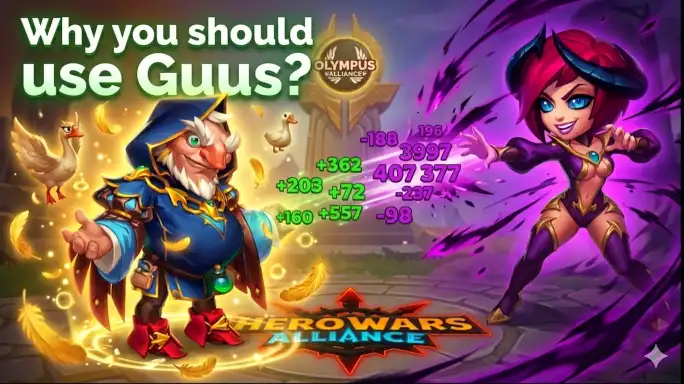
On the surface, Guus looks almost comical. A farmer. Three geese. Feathers everywhere. But the moment you understand what his mechanics are actually doing during a fight, that image disappears completely. What replaces it is a picture of one of the most efficient dual-role heroes in the entire game — a hero who simultaneously performs healing duties and critical support duties, doing two jobs at once and doing both of them well.
This matters for a specific reason. When a hero performs two roles successfully, your team-building constraints immediately relax. You need fewer healing slots. Fewer support compromises. Fewer awkward fits. Guus slides naturally into physical teams and survival-oriented compositions precisely because he fills gaps that would otherwise require two separate heroes to address.
And the foundation of everything he does rests on one core interaction: damage over time has a weakness that Guus exploits completely.
How Guus Turns Pressure Into Protection
Continuous damage continuously charges targets. Enemies dealing repeated hits are constantly accelerating cycles, feeding ultimates, triggering reactions, and building momentum. Most heroes are simply victims of this process. Guus is not.
While enemies apply their pressure, Guus activates. His geese scatter Golden Feathers across the battlefield. And suddenly the environment that damage over time had been exploiting starts working in the opposite direction. Teams become protected. Healing begins spreading evenly. Damage that previously felt overwhelming becomes manageable. Continuous pressure, the kind that usually breaks teams apart, becomes something you can survive through.
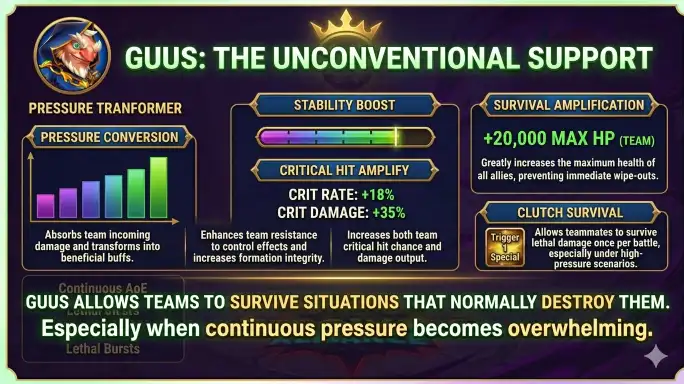
But Guus does not stop at simply surviving. Alongside the survivability increase comes something most players miss the first time they encounter it: additional Physical Critical Hit Chance for allies carrying his feathers. This means your team is not only lasting longer. It is also hitting harder. Critical hits become more frequent. Damage output climbs. Offensive pressure increases. What initially looks like a purely defensive hero is quietly turning your damage dealers into bigger threats at the same time.
Golden Feathers and the Cycle Mechanic
Understanding how Golden Feathers actually work is central to this Guus complete breakdown. When another Golden Feather is applied to an ally who already has one, the duration extends. That single sentence sounds simple, but the implications are significant.
Extending effects means maintaining cycles. Maintaining cycles means maintaining stability. And maintaining stability across a long battle is exactly where Guus becomes genuinely dominant, because his mechanics continuously reward repetition. The longer the fight goes, the more feather cycles have run, the more extensions have stacked, and the more established his system becomes across the team.
Then the geese return to work. Allies standing in front of Guus receive Golden Feathers again, and those feathers continuously restore health while active. Fragile allies survive hits they should not survive. Frontliners remain stable far longer than enemy teams plan for. Team structures hold together under sustained assault.
How Guus Answers Burst Damage
Continuous damage is one problem. Burst damage is a completely different one. And critically, this Guus complete breakdown would be incomplete without explaining how he addresses both simultaneously.
While Golden Feathers remain active, healing effectiveness increases. Recovery becomes stronger. Survival against burst windows becomes stronger. And then Beak Peak creates something genuinely frustrating for opponents to play around — because if an ally carrying Golden Feathers is about to fall below a dangerous health threshold, health restoration activates again before the finishing blow lands.
Burst damage that should finish off an ally suddenly fails. Enemies commit resources to a kill. Those resources disappear. The target survives. And that changes the entire tempo of a fight. The cost is that the feather disappears after triggering this protection. However, if losing a feather prevented a death, that trade is almost always worth making. The feather regenerates. Dead allies do not come back.
| Problem Guus Solves | Mechanic | Effect |
|---|---|---|
| Continuous damage pressure | Golden Feathers spread healing | Sustained survival improvement |
| Low offensive output | Feathers add Physical Crit Chance | Increased damage while surviving |
| Burst damage kills | Beak Peak threshold trigger | Emergency health restoration |
| Effects expiring too fast | Reapplication extends duration | Stable long-battle cycle |
| Need more offensive momentum | Honkageddon: crits spread feathers | Snowball system across the team |
Honkageddon and the Guus Complete Breakdown Snowball
Perhaps the most interesting mechanic in the entire Guus complete breakdown is Honkageddon. Critical hits normally produce extra damage. Guus decides to do something completely different with them. Instead, critical hits help distribute more Golden Feathers.
And now the entire system starts feeding itself. Allies with feathers deal stronger critical damage. Stronger crits spread more feathers. More feathers produce more crits. More crits spread even further. The snowball effect begins, and it expands progressively throughout the battle. More feathers. More criticals. More damage. More survival. More pressure on the opposing team.
Furthermore, this is precisely why long battles favor Guus. His system does not peak early and fade. It builds. The longer the fight continues, the more established his cycles become, the stronger his interactions stack, and the harder the team becomes to kill or outpace offensively. Patience actively rewards him.
Best Synergy Partners for Guus
No complete breakdown of Guus would make sense without examining the heroes who amplify what he already does well, and several stand out clearly from this analysis.
Kayla is immediately compelling because Kayla creates pressure through repeated attacks and aggressive positioning. Guus continuously supports survival behind those attacks and increases the critical opportunities that make Kayla’s aggressive style more dangerous. The combination is efficient because both heroes reward sustained, repeated combat rather than front-loaded bursts.
Yasmine is another strong pairing for this Guus complete breakdown. More critical interactions from Guus’s feather system naturally create stronger assassination potential, and Yasmine specifically thrives with critical support behind her. The additional Physical Critical Hit Chance that feathers provide feeds directly into what Yasmine wants to accomplish during a fight.
Drayne also becomes noticeably more dangerous alongside Guus. The additional offensive support that feathers provide naturally amplifies what Drayne is already attempting, and the survivability layers from the Beak Peak threshold protection give Drayne more time to establish the conditions she needs.
Why the Guus Complete Breakdown Changes How You See This Hero
The reason so many players underestimate Guus is the same reason they eventually become converts: the surface appearance does not match the reality. You see a farmer with geese. You do not see a hero who simultaneously addresses continuous damage, burst damage, offensive output, and team survivability through a single interlocking system that gets stronger the longer the battle runs.
Moreover, Guus is not simply healing and waiting. He is delaying destruction. He is stabilizing chaos that would otherwise spiral out of control. He is transforming enemy pressure into team survivability and simultaneously generating offensive value while doing it. That combination of defensive efficiency and offensive contribution in one hero is exactly the kind of thing that makes team building significantly easier.
Stability wins battles. And Guus, more than almost any other hero in Hero Wars Alliance, creates stability out of situations that looked like they were already lost.
Related Guides
- Astrid Best Talisman Guide 2026
- Secrets of the Dungeon Guide 2026
- Peech Complete Breakdown Guide
- Isaac Complete Breakdown Guide
Want to discuss Guus teams, share your builds, or ask about how he fits your roster? Come join the conversation on Olympus Alliance Discord — we are always around. Salute and friendship!