
Hero Wars Lumira Breakdown | New Light Titan


This Hero Wars Lumira Breakdown covers the mechanic most players completely miss — and once you understand it, fights that seemed impossible to win start making a lot more sense. Lumira does not just add power to your light team. Instead, she rewires how damage flows and shifts when your totem fires, all through two skills that work together in ways the tooltips do not fully explain.
What Makes Lumira Different?
Most light titans add damage or sustain. Lumira does something more specific — she controls tempo. Her entire kit is built around Apollo, a companion she summons who changes where damage lands, how long your titans survive, and when your totem fires. To understand why that matters, you need to understand both of her key skills.
Skill 1 – Apolotropy: The Living Shield

When Lumira activates Apolotropy, Apollo arrives on the battlefield with his own health bar. He is not a flash effect or a brief visual — he lands and immediately creates an aura around himself that covers nearby allied titans.
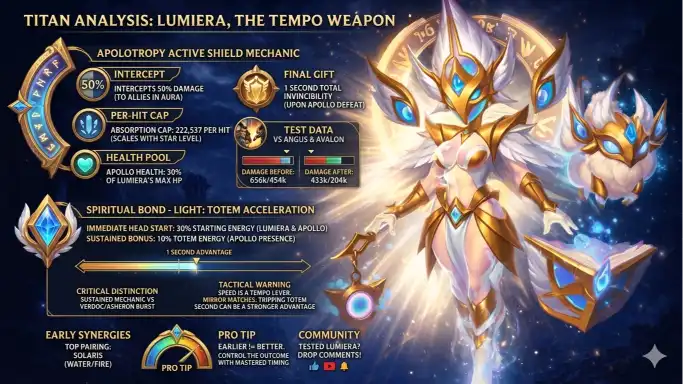
Every attack that hits allied titans inside that aura, Apollo intercepts 50% of that damage, up to 222,537 per hit at full scaling. That damage never reaches your titans. It goes into Apollo instead. Because his health is set at 30% of Lumira’s maximum health, he survives long enough to absorb a meaningful amount before he falls.
He is not a summon. He is a shield that breathes. And when he finally dies, it is not over — every allied titan inside the aura becomes completely invincible for 1 full second. One more second. One last gift.
Apollo in Action: The Numbers
To show exactly what Apollo does in practice, Zeus ran a clean two-versus-two test: Angus and Avalon versus Rigel and Lumira. No distractions, just raw numbers before and after Apollo activates.
Apollo was absorbing around 233,000 per attack in that test — and that number is actually below the tooltip cap because Zeus’s Lumira was not yet at six stars. The cap scales with star level, so at full investment those numbers go even higher. Watch Avalon’s damage collapse from 656k down to 433k in real time. That is hundreds of thousands of damage pulled away from Rigel every single hit, going straight into Apollo instead. He is eating the damage so your titans do not have to.
His health bar drops visibly with each attack. The moment it runs out, the invincibility kicks in. In a close fight, that 1-second window is often the difference between your titan surviving to cast his ultimate or not.
Skill 2 – Spiritual Bond: The Timing Lever

Most players glance at Spiritual Bond, see the 10% extra totem energy bonus, and move on. That is the wrong way to read it.
On paper, that 10% looks lower than what other summoner-type titans like Verdoc, Asheron, or Titus provide through their own summon mechanics. If you stop at the tooltip, you might think Lumira is actually the weaker choice for totem acceleration. She is not.
The key difference is Apollo’s health pool. Because he has his own health bar, he stays on the battlefield far longer than a typical summon effect that appears and disappears quickly. The longer he is present, the more that 10% bonus has time to accumulate. Other summoners might generate a bigger burst of totem energy the moment their summon activates — but Apollo’s durability means Lumira’s contribution builds over a longer window.
Why 30% Starting Energy Changes Everything
Both Lumira and Apollo start every battle with 30% energy already loaded. Before a single attack lands, Lumira is already ahead of almost every other titan in the game.
Zeus compared Lumira paired with Solaris directly against Solaris paired with Iyari. The combination of that head start and Apollo’s sustained battlefield presence made the light totem activate approximately 1 second earlier with Lumira in the lineup.
One second matters more than it sounds. It means your totem fires before their front-line titan casts his ultimate. It means your team survives a hit that would have ended the fight. It means the entire momentum shifts because your timing was different from what they prepared for.
The Timing Warning You Cannot Ignore
Earlier is not always better. If the enemy is also running light titans, the team that triggers the totem second can sometimes hold the stronger timing advantage. In those matchups, Lumira’s speed becomes a liability if you are not thinking about it.
Spiritual Bond is not a passive bonus you switch on and forget. It is a timing lever, and you need to pull it deliberately — not accidentally. The players who understand that will be the ones controlling the outcome. Everyone else will be reacting and wondering why their totem timing keeps feeling slightly off.

Hero Wars Lumira Breakdown: Best Pairings So Far
From early testing, the strongest results are coming from Lumira paired with Solaris, particularly in water and fire combinations. That pairing consistently outperforms everything else tested so far.
It is worth being clear — this is still early data. More battles and more matchup testing are needed before committing to a final answer on the best setups. However, based on current results, Lumira plus Solaris is the combination to start building around.
Is Lumira the Best Light Titan Right Now?
This Hero Wars Lumira Breakdown makes one thing clear — she is not just another light titan. She is a tempo weapon. Apollo changes where damage lands. The invincibility window protects your team at the moment it is most exposed. The 30% starting energy and Apollo’s sustained battlefield presence push your totem timing forward in a way that can completely catch your opponent off guard — or backfire if you are not reading the matchup.
The players who master her timing early will be setting the pace of fights while everyone else is still trying to catch up. The question is — are you going to be one of them?