
Julius vs Iris Explained | Hero Wars Alliance


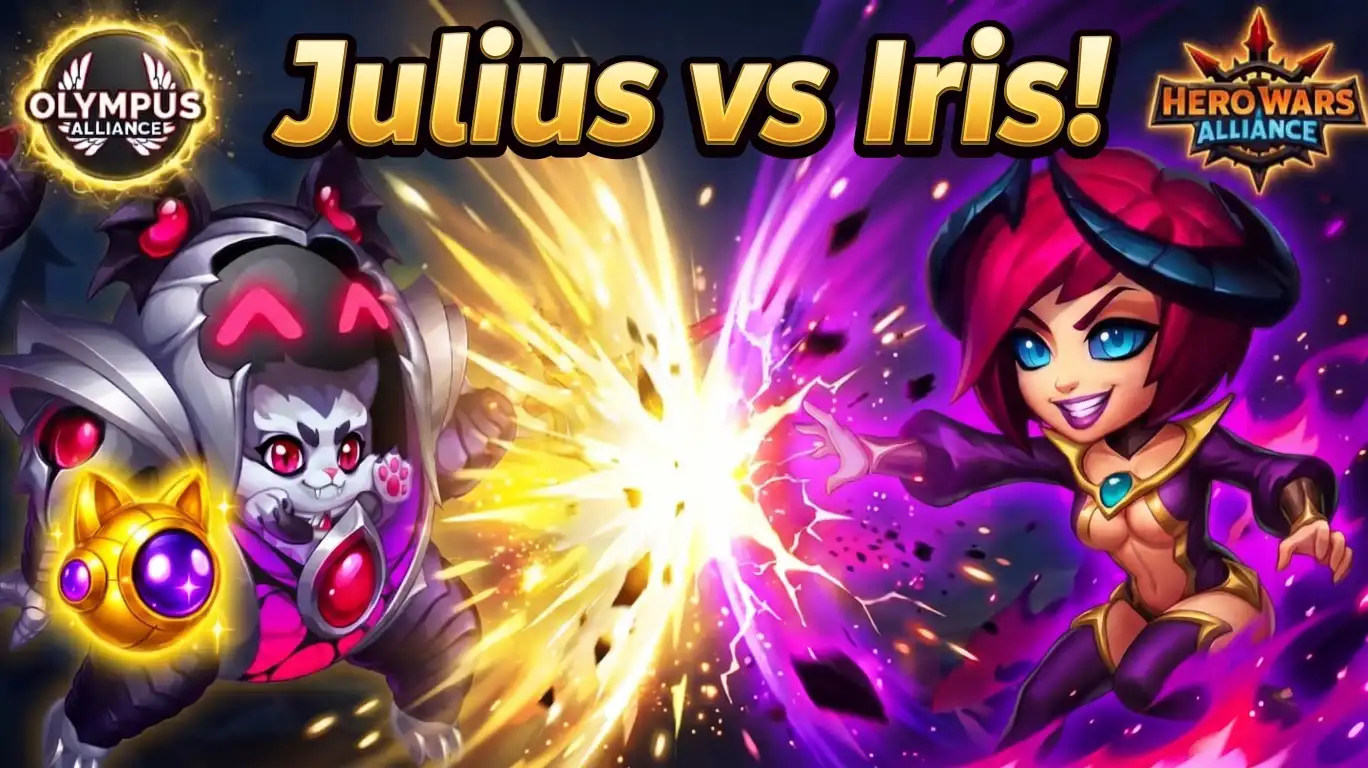
Julius vs Iris Explained: this is the interaction every Hero Wars Alliance player has been asking about since Julius’s Level 20 Relic arrived. The relic description says that whenever Julius or an ally gains a Shield, all negative effects are removed from that Hero. So what does that actually mean for Damage over Time?
Does the DoT disappear? Does it keep ticking? Or does Julius only clear the other negative effects while the damage carries on? Instead of guessing from the tooltip, we took it straight into battle and tested it.
The Level 20 Relic Question
On paper, Julius’s Level 20 Relic sounds simple. Every time a Shield lands on Julius or an ally, that Hero is cleansed of all negative effects. However, Damage over Time is a special case, because many players weren’t sure whether an active DoT counts as a removable negative effect or keeps running once it has been applied.
That distinction matters a lot. If DoT survives the cleanse, Iris stays just as oppressive as before. On the other hand, if the Shield wipes it, Julius becomes one of the clearest direct answers to DoT we have seen in the game.
How We Tested Julius Against Iris
For this test, we deliberately used a team capable of applying multiple buffs, debuffs and negative effects. In particular, we focused on Iris and her Inner Fire, since it gives us a DoT that is very easy to follow during the fight.
Phase 1: Inner Fire Starts Ticking
At the start of the battle, Iris applies Inner Fire. Right away, the damage begins to tick, hit after hit, and the target’s Health keeps dropping. In other words, the DoT is clearly active and doing its job.
Phase 2: Julius Applies a Shield
Then Julius applies a Shield, and this is the moment to watch carefully. The negative effect is removed and the Damage over Time stops immediately.
Later in the same fight, Inner Fire is applied again and becomes active once more. As expected, the damage returns and starts ticking. When Julius provides another Shield, the negative effect is cleared again and the damage stops a second time.
Don’t Trust the Animation, Watch the Damage
There is one detail that can easily confuse you. After the Shield lands, the visual effect of Inner Fire can still remain on the Hero. You can literally still see it.
As a result, if you judge the interaction only by what is displayed on the Hero, you might think Inner Fire is still working. Ignore the animation and look at the damage numbers instead. There are none. The visual stays behind, but the active damaging effect is gone.
The Verdict: Shields Remove Active DoT
So now we have our answer. Yes, based on what we saw in these battles, Julius’s Level 20 Relic removes an active Damage over Time effect when that Hero gains a Shield.
Keep in mind that this isn’t only about Iris. We used Inner Fire because it is a powerful, clearly visible DoT that we could track through the whole battle. What really matters is the mechanic itself: whenever Julius or an ally gains a Shield, all negative effects are removed from that Hero.
Is Iris Useless Against Julius Now?
Absolutely not. And Damage over Time is not finished against Julius teams either. The second part of our test shows exactly why.
Windows of Opportunity
Julius cannot remove everything at every single moment of the battle. First, the Shield has to be applied. If it doesn’t arrive at the right time, there is a window where the negative effect stays active, and that is when DoT gets to do its job.
With Heroes such as Iris and Tempus, that window can be extremely dangerous. Their damage comes incredibly fast, so if they get enough time before the next Shield, they can push a team down very quickly. That is exactly what we saw in the next battle.
In short, there are two sides to this interaction. When Julius’s Shield arrives, the negative effect is removed and the DoT stops. Meanwhile, whenever there is a gap between Shields, Iris and Tempus can take full advantage of it.
Julius vs Iris Explained: A Team Battle, Not a Duel
This is where people need to understand something important about Julius. He doesn’t operate alone, and one Hero doesn’t win a five-Hero battle. Rather than Julius versus Iris, it’s one complete team against another complete team.
Moreover, the Julius team in our test didn’t have every possible source of sustain or every tool for closing those vulnerable windows. Therefore, the real question becomes: how do we make those windows smaller? That is where team synergy takes over.
Nebula: A Second Cleanse Layer
Nebula is a perfect example. She can also remove negative effects while providing healing at the same time. Consequently, Julius is no longer the only Hero answering negative effects, and your team gains another layer of cleansing plus another source of sustain.
Crow: Stop the Problem Before It Starts
Crow attacks the same problem from a completely different angle. His Silence can be extremely intense. Instead of only removing negative effects after the enemy applies them, Silence disrupts the enemy and reduces their chances to operate properly in the first place.
| Tool | How It Shrinks the DoT Window |
|---|---|
| Julius (Level 20 Relic) | Every Shield on Julius or an ally removes all negative effects, including active DoT |
| Extra Shield Heroes | More Shields means more cleanse triggers and shorter gaps between them |
| Nebula | Second source of negative-effect removal, plus healing to survive the gaps |
| Crow | Silence disrupts the enemy before they can set up their damage |
This is where Julius’s Relics become really impressive. It’s not simply a case of Julius getting a Shield and the negative effect vanishing. What counts is everything you can build around that mechanic, stacking Shields, cleanses, healing and disruption until the windows for Damage over Time become smaller and smaller.
Even so, they are still windows. If Iris gets one, she can punish you, and Tempus can do the same. If the Shield doesn’t land at the right moment, the damage passes through and the team can fall.
Why This Makes the Meta More Balanced
Julius’s Level 20 Relic being powerful does not mean Iris has lost her value. She is still extremely dangerous, and so is Damage over Time in general. What has changed is that there is now another answer to it.
For us, that is a good thing. When Iris and DoT were introduced, one of the biggest problems was how hard it was to find a real counter. Because there were so few direct answers, DoT could feel incredibly oppressive.
Now those answers are starting to appear, and Julius’s Level 20 Relic is one of the clearest examples. It doesn’t destroy Iris, nor does it make DoT irrelevant. Instead, it makes the interaction more balanced. If Julius gets the Shield at the right time, he has an answer. Conversely, if the opponent creates the right window, the DoT gets through, and the rest comes down to the five Heroes you picked and the synergy you built around them.
Final Thoughts
That’s why Julius vs Iris Explained isn’t a story about Julius killing Iris. It’s a story about counterplay, building a team that shrinks the opponent’s opportunities while they try to create them.
After seeing the Level 20 Relic working in battle, we consider it a massive point for Julius. The description already sounded strong, but watching it tells us much more: the Shield isn’t just absorbing damage, it can shut down an active negative effect. As long as your team keeps generating Shields, healing, removing effects and disrupting the opponent, those dangerous windows become harder and harder to find.
Still, they never disappear completely. Timing, team building and synergy all still matter, and Iris absolutely keeps her value. Julius simply gives us another weapon against a mechanic that previously had very few direct answers, not because he is unbeatable, but because he opens up completely new battles around Shields, negative effects and Damage over Time.
So the challenge is simple. Build the right team around Julius, reduce those windows as much as possible, and force your opponent to find another way through. After all, Julius alone isn’t the answer. The synergy of all five Heroes is.
Related Hero Wars Alliance Guides
Julius or Iris, Whose Side Are You On?
Share your Julius team builds, DoT counters and battle results with the community in the Olympus Alliance Discord.